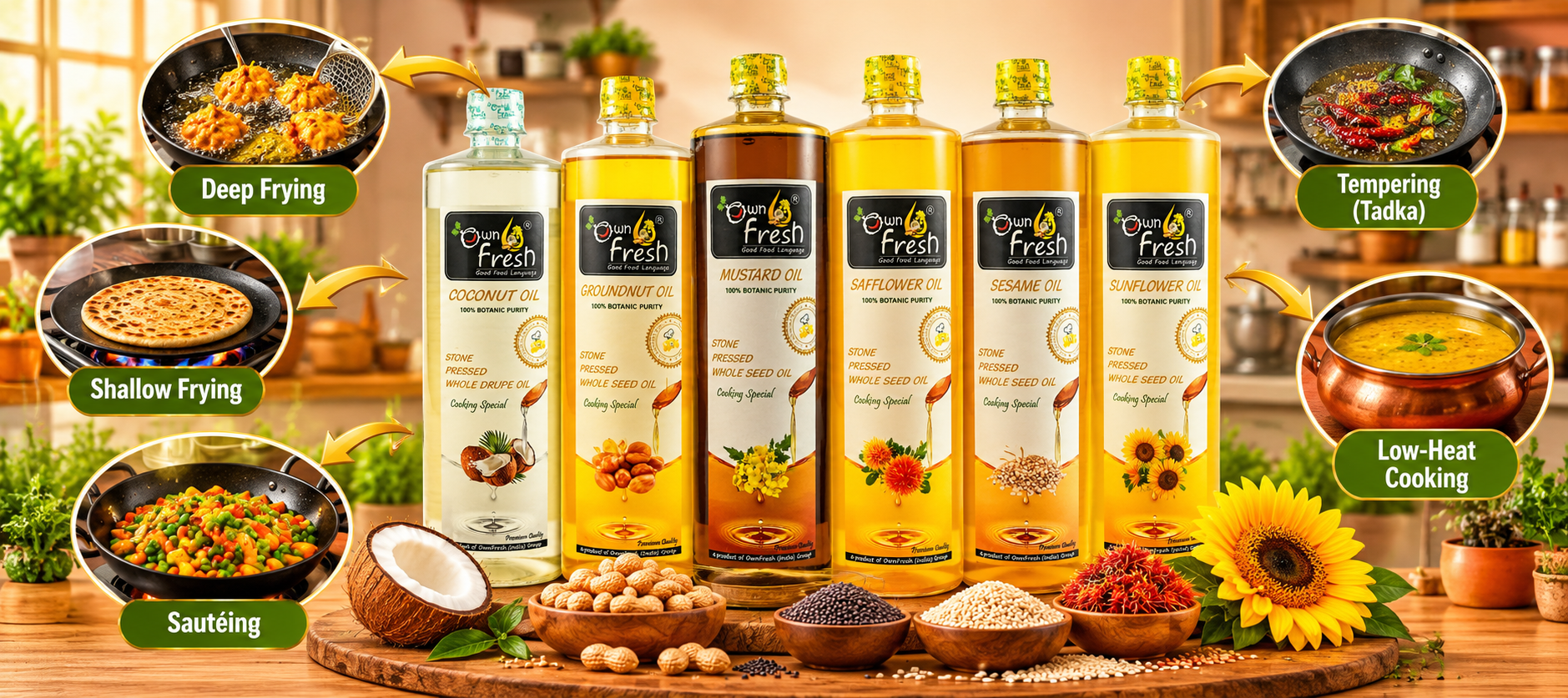
Most Indian kitchens reach for the same bottle of oil whether they are tempering cumin for dal, deep-frying puris, or finishing a coconut-based thoran. That habit costs you in flavour, nutrition, and sometimes safety. Each stone-pressed oil has a distinct smoke point, fatty-acid profile, and aromatic signature that makes it shine in specific techniques — and underperform or even degrade in others. The traditional wisdom our grandmothers practiced was not brand loyalty; it was oil rotation — matching the right fat to the right heat. Below is a practical, science-backed framework to bring that wisdom back to your stove.
Table of Contents
- 1. Why One Oil Cannot Do It All
- 2. The Science: Smoke Points & Fatty-Acid Stability
- 3. The Oil-by-Oil Rotation Map
- Tadka & High-Heat Tempering (180–250 °C) — Mustard Oil, High-Oleic Sunflower Oil
- Deep-Frying & Prolonged High Heat (180–200 °C sustained) — Groundnut Oil, High-Oleic Sunflower Oil
- Everyday Sauté & Sabzi (140–170 °C) — Groundnut Oil, Sesame Oil
- Low-Heat Simmer, Dal Finishing & Raw Drizzle (≤120 °C) — Sesame Oil, Virgin Coconut Oil
- Baking & Moderate Oven Work (160–180 °C) — Groundnut Oil, High-Oleic Sunflower Oil
- 4. Practical Kitchen Workflow
- 5. Storage, Shelf Life & Freshness Signals
- 6. Frequently Asked Questions
- Can I use stone-pressed groundnut oil for deep-frying multiple batches?
- Is virgin coconut oil healthy for daily cooking given its saturated fat content?
- Why does my mustard oil taste bitter after heating?
1. Why One Oil Cannot Do It All
Refined oils are stripped of colour, aroma, and heat-sensitive nutrients precisely so they can survive a single, high-temperature deodorisation step (240 °C+). The result is a neutral, shelf-stable fat that looks like an all-rounder but delivers none of the phytosterols, tocopherols, or polyphenols that make traditional oils protective. Stone-pressed oils — extracted below 45 °C on granite ghani — retain those compounds, but they also retain their natural thermal limits. Heating cold-pressed groundnut oil past 160 °C or virgin coconut oil past 175 °C burns off antioxidants and can generate polar compounds and free radicals. Conversely, using a delicate finishing oil for a rolling tadka wastes its nuance. Rotation is not a trend; it is the only way to honour both the chemistry of the fat and the diversity of Indian cooking.
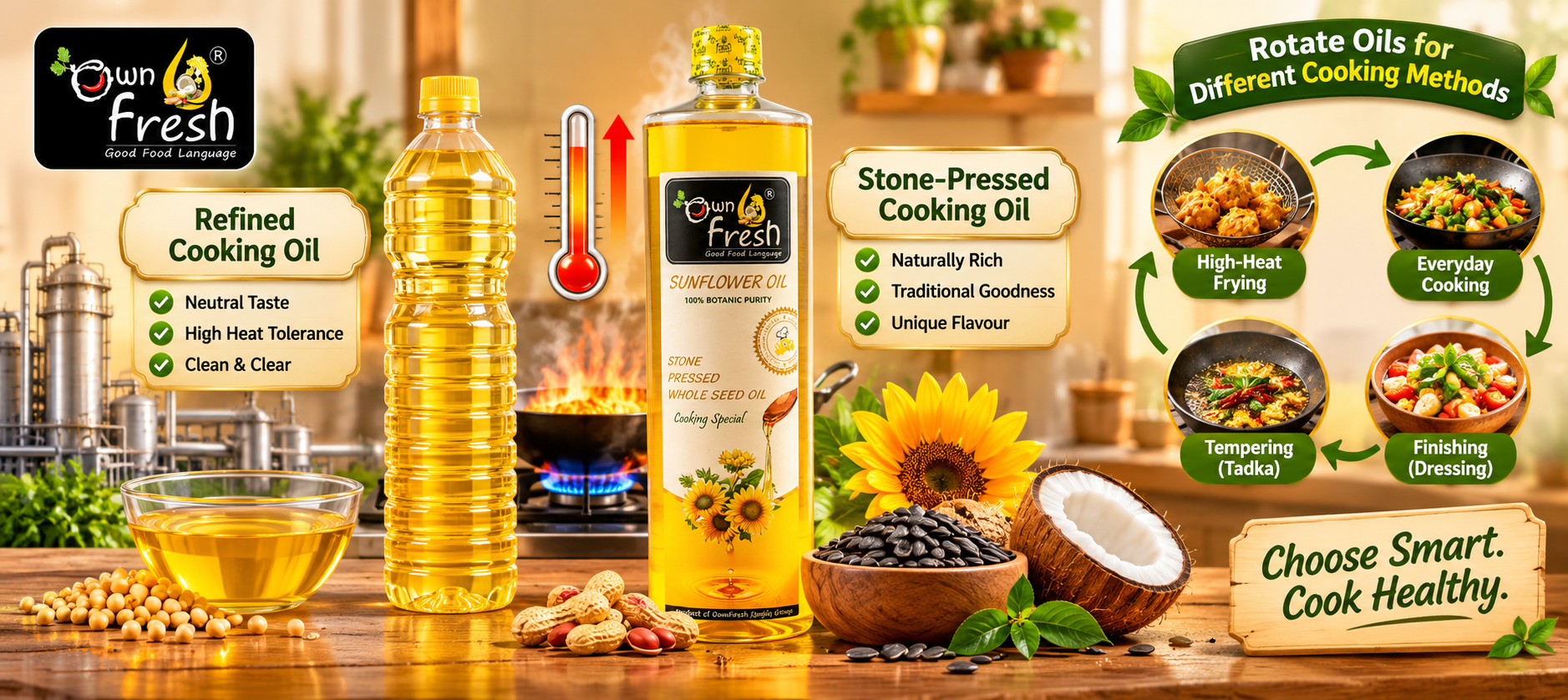
"The healthiest approach for any Indian household is rotating oils mindfully and matching the right oil to the right cooking technique." — Dr. Shabana Praveen, Clinical Nutritionist
2. The Science: Smoke Points & Fatty-Acid Stability
Smoke point is the temperature at which an oil visibly smokes and begins to break down into glycerol and free fatty acids. But the functional limit for nutrient retention is lower — typically 20–30 °C below the smoke point for cold-pressed oils. Fatty-acid composition determines stability: saturated fats (SFA) resist oxidation best, monounsaturated fats (MUFA) moderately, polyunsaturated fats (PUFA) least. Stone pressing preserves natural antioxidants (tocopherols, phytosterols, lignans, sesamol) that buffer oxidation, but they are not infinite shields.
| Oil (Stone-Pressed) | Typical Smoke Point | MUFA % | PUFA % | SFA % | Key Antioxidants |
|---|---|---|---|---|---|
| Groundnut | ~230 °C (crude) | 46–50 (oleic) | 30–33 (linoleic) | 12–16 | Vitamin E 15–16 mg/100 mL (α + γ-tocopherol), phytosterols ~207 mg/100 g, resveratrol |
| Mustard (kachi ghani) | ~250 °C (raw, pungent) | 55–60 (oleic + erucic) | 15–20 (α-linolenic ω-3) | 10–12 | Sinigrin (glucosinolate), tocopherols, phytosterols |
| Sesame | ~210 °C | 38–43 (oleic) | 42–46 (linoleic) | 10–14 | Sesamol, sesamin, sesamolin, γ-tocopherol |
| Coconut (virgin) | ~175–200 °C | 6–8 (oleic) | 1–2 | 88–92 (lauric 48–53 %) | Polyphenols, traces of tocopherols (refining drops tocopherols 99 %) |
| Sunflower (high-oleic, stone-pressed) | ~225 °C | 75–82 (oleic) | 8–12 (linoleic) | 8–10 | Vitamin E 40–50 mg/100 g, phytosterols |
Rule of thumb: High MUFA + natural antioxidants = better high-heat tolerance. High PUFA = reserve for low-heat or finishing. High SFA (coconut) = stable at moderate heat but solidifies below 24 °C — plan for that.
3. The Oil-by-Oil Rotation Map
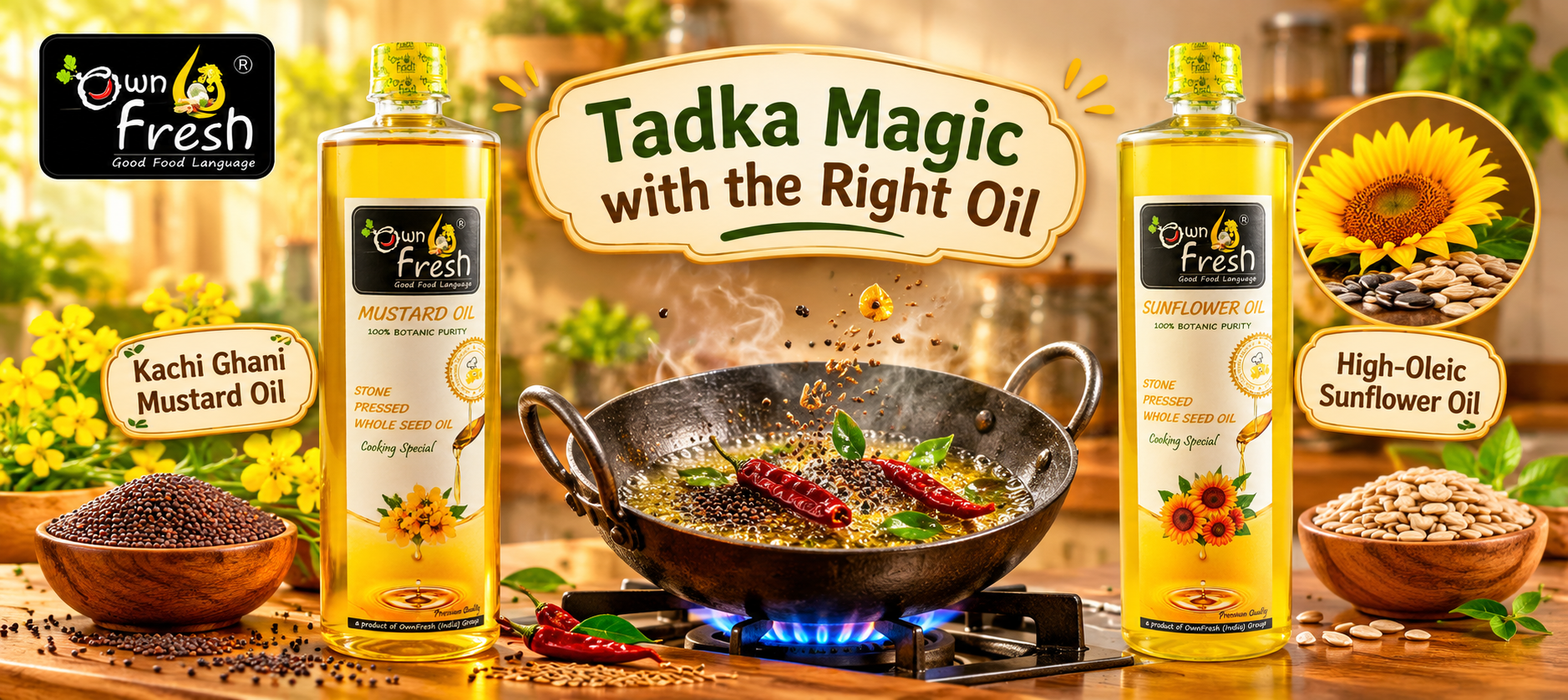
Tadka & High-Heat Tempering (180–250 °C) — Mustard Oil, High-Oleic Sunflower Oil
North and East Indian tadkas demand oil that hits 220 °C+ without burning. Kachi ghani mustard oil's raw pungency mellows into a nutty backbone at temperature, and its 15–20 % α-linolenic acid (plant ω-3) survives brief heat better than most PUFA sources. High-oleic stone-pressed sunflower oil (75 %+ oleic) is a neutral alternative when you want the heat tolerance without mustard's assertive flavour. Both carry enough natural tocopherols to buffer the 30–45 second tadka window.
Deep-Frying & Prolonged High Heat (180–200 °C sustained) — Groundnut Oil, High-Oleic Sunflower Oil
Puris, pakoras, bhaturas need oil that holds 190 °C for 10–15 minutes per batch. Crude stone-pressed groundnut oil's measured smoke point (~230 °C) and 46–50 % oleic acid give it the oxidative stability for repeated batches — filter between uses and retire after 3–4 cycles. High-oleic sunflower oil performs similarly with a cleaner flavour profile. Avoid mustard oil here; its glucosinolates can develop bitter notes over long fry sessions.
Everyday Sauté & Sabzi (140–170 °C) — Groundnut Oil, Sesame Oil
This is the workhorse zone: onions browning, tomatoes breaking down, spices blooming. Cold-pressed groundnut oil's vitamin E (15–16 mg/100 mL) and phytosterols (~207 mg/100 g) survive gentle sauté intact, enriching the dish. Stone-pressed sesame oil adds its signature nutty depth — ideal for Tamil Nadu poriyals, Andhra pappu, or any dish where you want the oil to be tasted. Keep the pan below 170 °C; sesame's PUFA content (42–46 %) makes it vulnerable above that.
Low-Heat Simmer, Dal Finishing & Raw Drizzle (≤120 °C) — Sesame Oil, Virgin Coconut Oil
South Indian rasam, sambar, and chutney finishes; Gujarati dal drizzle; podi rice. A teaspoon of sesame oil at the end delivers sesamol and lignans (antioxidant, anti-inflammatory) unaltered. Virgin coconut oil — solid below 24 °C — melts instantly into hot dal or steamed rice, contributing lauric acid (48–53 %) and a sweet, tropical aroma. Neither should see a hot pan.
Baking & Moderate Oven Work (160–180 °C) — Groundnut Oil, High-Oleic Sunflower Oil
Swap refined vegetable oil in cakes, cookies, and breads for stone-pressed groundnut or high-oleic sunflower oil. Their MUFA dominance keeps crumb tender without oxidising in a 170 °C oven for 20–30 minutes. Expect a subtle nutty note — pleasant in banana bread, less so in delicate vanilla sponge.
4. Practical Kitchen Workflow
Keep three bottles on the counter, not one:
- Bottle A (High Heat): Kachi ghani mustard oil OR high-oleic stone-pressed sunflower oil — for tadka, deep-fry, searing.
- Bottle B (Daily Sauté): Stone-pressed groundnut oil — for sabzis, stir-fries, baking, general purpose.
- Bottle C (Finish & Flavour): Stone-pressed sesame oil AND/OR virgin coconut oil — for drizzle, chutney, podi, South Indian tempering.
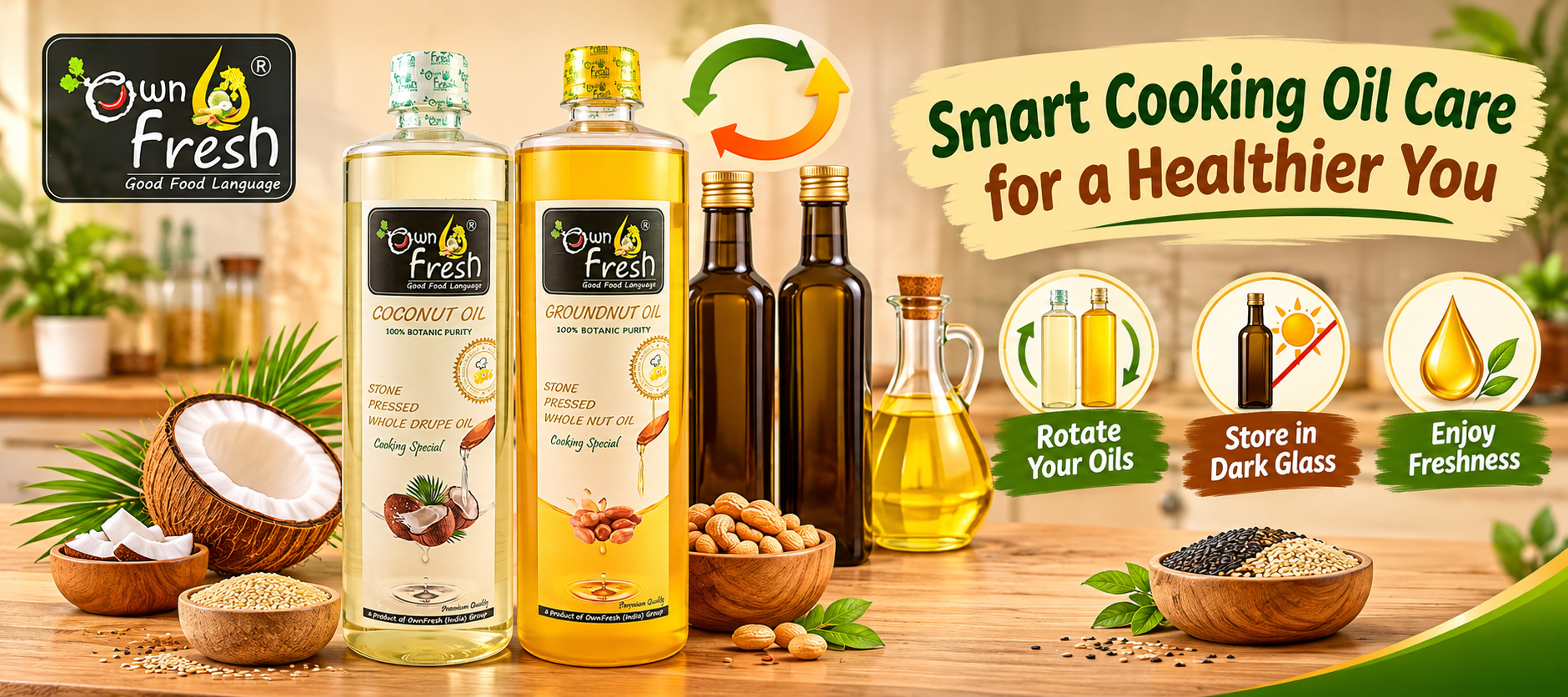
Rotate Bottles A and B every 2–3 months to diversify fatty-acid intake (ICMR-NIN recommends variety). Store all stone-pressed oils in dark glass, away from the stove. Buy in 500 mL or 1 L sizes you'll finish within 60–90 days — cold-pressed oils have 3–6 month shelf life once opened. Smell before each use; rancidity reads as crayon, putty, or old nuts.
5. Storage, Shelf Life & Freshness Signals
Stone-pressed oils lack synthetic stabilisers (TBHQ, BHT) — that is the point. Their freshness clock starts at pressing. Groundnut and sesame oils last 3–4 months opened; mustard 3–4 months; virgin coconut 6–12 months (saturated fat resists oxidation). Refrigeration extends life but clouds coconut and sesame oil — warm to room temperature before use. Sediment at the bottom of a groundnut or mustard bottle is natural waxes and seed particulates, not spoilage; shake gently.
If an oil smells like oil paint, play-dough, or stale peanuts, discard it. Oxidised oil delivers lipid peroxides, not nutrition. OwnFresh stamps a press date on every bottle — use that, not a generic "best before."
6. Frequently Asked Questions
Can I use stone-pressed groundnut oil for deep-frying multiple batches?
Yes. Crude stone-pressed groundnut oil tests at ~230 °C smoke point. Filter through muslin after each session, store cool and dark, and retire after 3–4 fry cycles. Total polar compounds stay within safe limits well beyond that, but flavour and antioxidant levels decline. For commercial-volume frying, a refined high-oleic oil is more economical; for home batches, stone-pressed groundnut is excellent.
Is virgin coconut oil healthy for daily cooking given its saturated fat content?
In moderation, within a rotation — not as your sole oil. A 2019 Circulation meta-analysis (16 trials) found coconut oil raised LDL +10.47 mg/dL vs non-tropical vegetable oils. Its strength is nutrient retention (polyphenols, lauric acid) and flavour in South Indian dishes. Use it for tempering thoran, finishing avial, or baking — pair with groundnut or mustard oil for the rest of your cooking to balance saturated fat intake.
Why does my mustard oil taste bitter after heating?
Kachi ghani mustard oil contains sinigrin, a glucosinolate that breaks down to allyl isothiocyanate (the pungent compound). At prolonged high heat (>3 minutes above 200 °C), this degrades further into bitter nitriles. For tadka — 30–45 seconds at smoking heat — it mellows beautifully. For long sautés or deep-frying, switch to groundnut or high-oleic sunflower oil.
Ready to rotate? Explore OwnFresh's range of granite stone-pressed oils — groundnut, mustard, sesame, coconut, and sunflower — each pressed below 45 °C, unrefined, chemical-free. Shop the rotation at myownfresh.com.