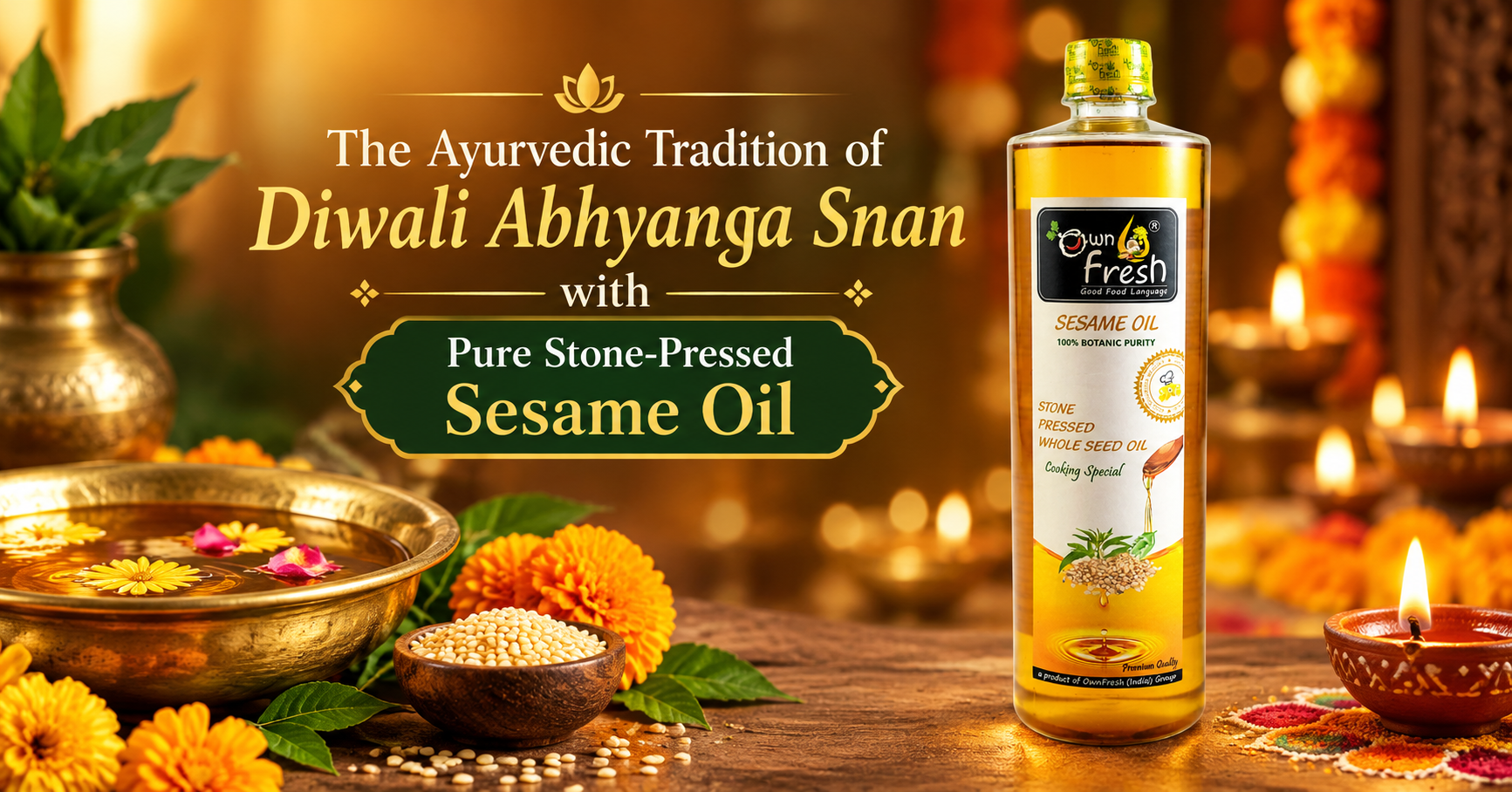
Abhyanga snan is the Ayurvedic practice of warm oil self-massage followed by bathing, and sesame oil is its traditional oil of choice. It sits at the centre of Dinacharya, the Ayurvedic daily routine, and it is prescribed most strongly in winter — the season when Ayurveda says vata dosha naturally intensifies. Around Diwali, with evenings drawn out, lamps lit and routines disrupted, the practice gets particular attention, and stone-pressed sesame oil is the product the tradition is built around.
This article walks through what the practice actually involves, why sesame oil rather than a cosmetic body oil, what the science says about the compounds sesame carries, and where the honest boundaries of the claims sit.

1. What Abhyanga Snan Is
Abhyanga is warm oil applied to the body using deliberate massage strokes; snan is the bath that follows, washing the oil off. The two are meant as a single practice, not separate steps. Classical texts place it in the morning, before bathing, and describe a short warm-up to oil before application so the skin can absorb rather than reject it.
The Ayurvedic rationale is dosha-specific. Vata — associated with dryness, cold, movement and the nervous system — peaks in late autumn and winter. Warm oil massage is its countermeasure: warmth to offset vata's cold, oil to offset its dryness, and slow rhythmic strokes to encourage circulation and calm. Abhyanga is described in the Charaka Samhita among the practices that support strength, luster and longevity, and sesame oil specifically is cited as particularly suited to vata.
2. Why Sesame Oil Specifically
Sesame oil is not chosen because it is the richest or the most expensive. In Ayurvedic classification it is unctuous, light and mobile — qualities that suit a practice meant to move oil through tissue rather than leave a heavy film. It is warm in prakriti, which is the opposite of what winter and vata need.
There is also a practical reason. Ayurvedic sesame oil is characteristically untoasted, retaining a light, slightly nutty aroma without the heavy roasted note of Indian cooking sesame oil. That matters in a practice where the oil is applied to the whole body and left for twenty minutes; a heavily toasted oil would feel heavy and smell strongly.
And it is what cold stone pressing changes in measurable terms. Refining sesame oil strips the very compounds that make it distinctive: heat processing and acidic bleaching convert sesamolin into sesamol and sesaminol, and epimerise sesamin into episesamin, altering the active profile. Cold stone churned below 45°C, with no hexane, no bleaching clay and no deodorisation, leaves those compounds in the bottle intact.
Refined sesame oil is a cleaner, longer-lasting, cheaper product. It is also a different molecule. The lignans that give sesame oil its distinguishing character are what refining is designed to remove, and cold pressing below 45°C is what keeps them.
3. What the Science Actually Shows
The lignans
Sesame is one of the only food sources of significant lignan intake, and its two principal lignans, sesamin and sesamolin, are unique to it. Seed levels run 1,500–4,200 mg/kg for sesamin and 620–3,590 mg/kg for sesamolin, which is why sesame dominates dietary lignan content. In raw, unroasted seed, sesamolin and sesaminol are largely absent — they form during roasting and refining, which is exactly why cold-pressed oil's lignan profile differs from refined oil's.
The mechanism
A 2023 review in Food Science & Nutrition on sesame and atherosclerosis found sesame and its lignans appear to regulate oxidative enzymes — SOD, glutathione, GPx, catalase — and reduce TBARS and malondialdehyde, markers of lipid peroxidation. A 2022 study found sesame lignans activate AMPK and PPAR signalling, enhancing fatty acid oxidation and cholesterol efflux genes in hepatic cells.
Where the evidence stops
The clinical trials here are small and mostly mechanistic or animal-based. A Swedish trial in six volunteers quantified 27 urine metabolites after a single sesame oil muffin dose; work on cholesterol and oxidative markers shows direction but not the effect size a supplement claim would imply. Sesamin also inhibits CYP3A4 and CYP4F2, giving a real interaction signal with drugs metabolised by CYP3A4 — worth knowing if you take such medication.
4. Practising the Ritual at Home
- Warm the oil to body temperature plus a few degrees — around 37–40°C. Test on the inner wrist. Never hot enough to burn.
- Use roughly 150–200 mL for an adult whole body. Less leaves patchy absorption, more is simply waste.
- Stroke in the classical direction: on the limbs, from the joints outward toward the fingers and toes; on the trunk, along the spine and outward from the midline.
- Rest 20–30 minutes for the oil to absorb. Shorter rests give you most of the benefit for less time.
- Then bathe. Warm water first, then cool to close the pores. This is the snan.
Five to ten minutes of consistent daily massage delivers much of what the tradition claims. Winter and early morning are the classical windows, and Diwali's long evenings make it a natural time to begin the routine.
5. The Honest Limits
The claims circulating around abhyanga routinely outrun the evidence, and sesame oil deserves a straight answer.
- Sesame oil is not absorbed in clinically significant quantity. Percutaneous uptake of the bulk oil is minimal; any lignan exposure from massage is far below oral-dose trial levels. The benefit is mechanical and thermal — warmth, circulation, moisture, and the nervous-system effect of slow rhythmic stroking — not nutritional delivery.
- The longevity and anti-aging claims are classical, not clinical. Charaka Samhita statements about strength and longevity are part of a textual tradition, not modern trial results.
- The vata, dosha and pitta framework is Ayurvedic theory, not a validated diagnostic system. It is coherent internally and widely practised, but it is not interchangeable with clinical medicine.
- Do not apply to broken, infected or inflamed skin. Stop if you notice irritation.
What abhyanga reliably offers is what any sustained warm oil massage offers: skin hydration, relaxed muscles, better sleep and a genuinely calming nervous-system response. Those are worth the twenty minutes, and they are honest.
6. Storage, and a Note on Cooking Use
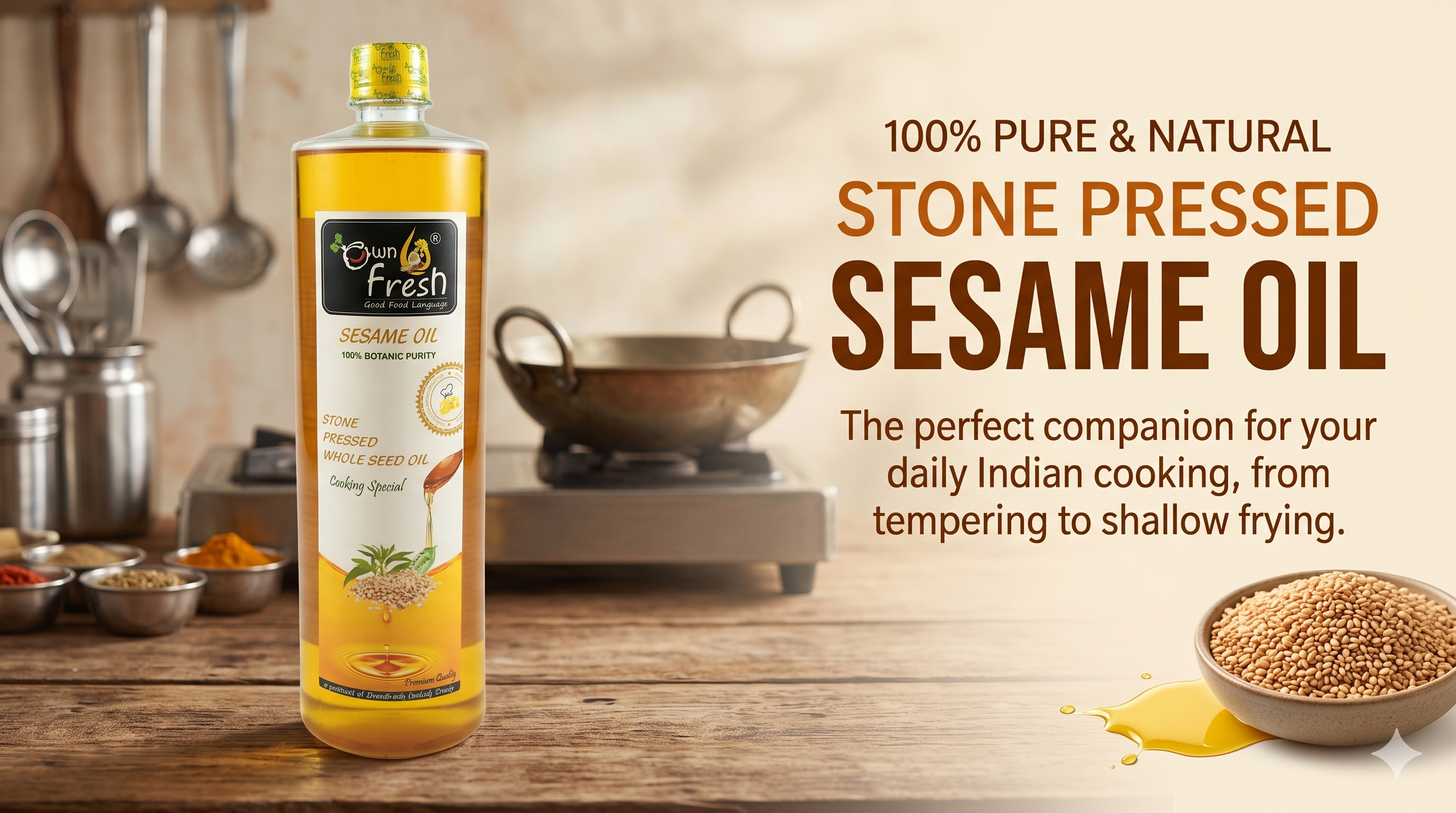
Store sesame oil in a cool, dark place in a tightly sealed container; light and heat degrade both vitamin E and lignans. It keeps well for a year or two, longer than most cold-pressed oils, because the lignans act as a built-in antioxidant defence.
Sesame oil has a strong case in the kitchen too. Cold-pressed sesame oil holds a smoke point around 215–230°C, above most unrefined oils, and performs well in tempering, shallow frying and daily sabzi. The roasted, deep-flavour profile of Indian cooking sesame oil comes from toasted sesame — a different step from the untoasted variety favoured for abhyanga — so a household may keep both, or use one across both purposes if the unroasted profile suits cooking.
7. Frequently Asked Questions
Can I use cooking sesame oil for abhyanga snan?
You can, but the traditional choice is untoasted sesame oil, which carries a lighter, cleaner aroma suited to whole-body application. Indian cooking sesame oil is made from toasted sesame and has a much stronger roasted flavour that can feel heavy when left on the skin for twenty minutes. Functionally it will still work; it is a matter of preference and scent tolerance, not safety.
Why is sesame oil considered the best oil for abhyanga?
Because it is classified in Ayurveda as unctuous, light and mobile, and warm in nature — the direct countermeasure to the dryness, cold and agitation of vata, which intensifies in winter. Its warmth and absorbability suit a practice meant to move oil through tissue. There is no clinical proof that it outperforms other oils; it is the historical and theoretical choice, and a reasonable practical one.
Is abhyanga snan scientifically proven?
Partly, and only in narrow terms. The massage itself reliably delivers skin hydration, muscular relaxation and better sleep, which is shared by any warm oil massage. The specific Ayurvedic claims about longevity and vata balance are classical rather than clinically validated, and sesame oil is not absorbed in clinically significant amounts through the skin. Treat it as a wellbeing practice with real comfort effects, not a therapeutic treatment.